Over the years I’ve come across a few proposals that any person or entity should able to issue their own currency, and I’ve always struggled about what that would mean and how it would work. This is relevant for recursive currency systems like the Credit Commons in which theoretically any member could create a currency… Continue reading
The Next Economy: worker led for public interest
Reposted from the , the programme features interview with our colleague and Platform Cooperativism co-originator Nathan Schneider, as well as political scientist and author Virginia Eubanks 10 years since the financial crash we’ve learned that there exists in the US not just one economy, but many, as well as many kinds of economic actors. From… Continue reading
ROAR Issue #8 : Beyond the Border
“I don’t believe in borders, I don’t like flags, I have no boundaries. My only homeland: friendship, love and justice for all.” Dedicated to the memory of Myra Landau (1926–2018) We are very excited to announce the launch of our eighth issue, on revolutionary internationalism in the twenty-first century. Beyond the Border features important contributions by a… Continue reading
Essay of the Day: Democratic legitimacy and new commons: examples from English protected areas
The following paper was authored by Margherita Pieraccini and originally published on the International Journal of the Commons. Abstract If the purpose of traditional commons is sustainable resource exploitation, the primary objective of these new commons is the conservation of nature/protection of biodiversity. And if on traditional commons local resource users are the key beneficiaries, in… Continue reading
What to do once you admit that decentralizing everything never seems to work
Decentralization is the new disruption—the thing everything worth its salt (and a huge ICO) is supposed to be doing. Meanwhile, Internet progenitors like Vint Cerf, Brewster Kahle, and Tim Berners-Lee are trying to re-decentralize the Web. They respond to the rise of surveillance-based platform monopolies by simply redoubling their efforts to develop new and better decentralizing technologies. They… Continue reading
Open 2018: Richard Bartlett and Natalia Lombardo on Patterns for Decentralised Organising
Richard Bartlett and Natalia Lombardo from Loomio running a shorter version of their excellent workshop on Patterns for decentralised organising. If you work in any type of co-operative or non-hierarchical group and are interested in improving efficiencies and developing more successful collaboration within your team/s, this workshop is for you. There are also some useful shared notes and links in the working doc… Continue reading
Guy Standing’s Commons Fund for the Precariat.
In this extract from a must-read essay published on The Great Transition Initiative, Guy Standing proposes a Commons Fund for the precariat. Guy Standing: Given that wages cannot be expected to provide the precariat with security, the system must find alternative ways of doing so. The secret lies in capturing rental income for society. We should… Continue reading
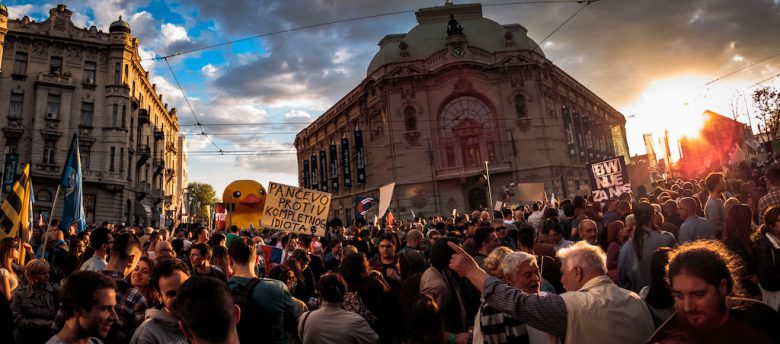
Belgrade, Serbia: Ne da(vo)mo Beograd Takes on Luxury Development
Ne da(vi)mo Beograd (Don’t let Belgrade Drown) was formed in 2014 in protest at the huge urban projects that aimed to turn an area of the capital’s historic city waterfront into luxurious commercial and residential buildings. By objecting in a variety of ways, from institutional engagement to civil disobedience, Ne da(vi)mo Beograd has kept the… Continue reading
The Insurgent Power of the Commons in the War Against the Imagination
As readers may have noticed, I have not been blogging much in recent months. That’s because I’ve been completing a new book with my colleague Silke Helfrich that has been consuming most of my time. (More about that soon.) Fortunately, only a month or so is left before we finish the manuscript! At that point… Continue reading
The Response 1: Radical approaches to disaster relief in New York
Cross-posted from Shareable. How do we respond to natural disasters? What comes to mind? Large relief organizations like the American Red Cross? Or perhaps the Federal Emergency and Management Agency? Well, those images are certainly part of the story — but they’re not the whole story. In our new podcast series, The Response, we aim to… Continue reading