It … proceeds from a perspective that already presumes a neoliberal subject and an economic mode of governance in the face of social and/or political problems. ‘How do we manage and incentivise individual competitive economic agents?’ In doing so, it not only codes for that subject, we might argue that it also reproduces that subject…. Continue reading
Procomuns Plenary 8: Public Policies for Collaborative Economies
Video exploring the current situation at the level of the City Councils, Generalitat, Central Administration and European Commission. What are the different roles of the administrations? A debate about the most appropriate models of collaborative economy to be promoted from the administrations, with Mara Ballestrini, Carolyn Hassan, David Hammerstein, Adrián Todolí and Ivana Pais. Note:… Continue reading
Project Of The Day: Community Shares
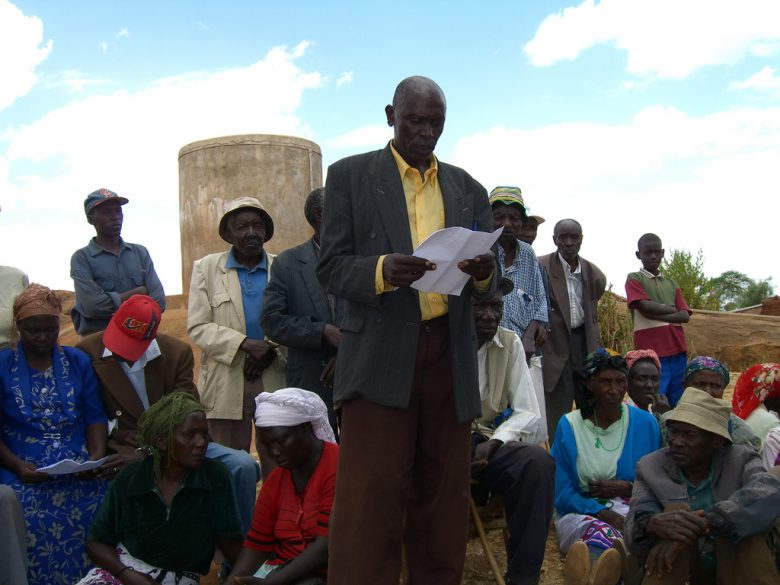
When I lived in Kenya, my friend, Kamau, needed to raise funds to purchase the storefront where he operated his grocery business. Even with a distant relative in the local bank, he could only borrow half the funds he needed. I offered to help some, but my contribution wouldn’t come close to covering the other half…. Continue reading
Matt Damon: In Defense of Civil Disobedience
“The rule of law maximizes injustice. The rule of law is the darling of the leaders and the plague of the people. We ought to begin to recognize this. What we are trying to do is to get back to the principles, the aims and the spirit of the Declaration of Independence. This spirit is resistance to… Continue reading
A Status Report on the FairCoop project
The infrastructure of the FairCoop is now sufficiently in place for it to be useful, the next step is getting more participation from the public and creating a ‘network effect’ which will multiply its usefulness. A contribution by Guy James: “The Fairmarket is up and running in beta version at https://market.fair.coop, you can see the… Continue reading
“You can’t code away their wealth”: Dmytri Kleiner explains why the construction of P2P alternatives is conflictual
This is one of the must-see, must-listen-to videos to watch this year! Brilliant explanation by Dmytri Kleiner on the ‘transvestment‘ approach, i.e. how to transfer value from the system of capital to the system of peer production. Kleiner explains for example why federated systems, depending on servers and investments, can’t compete with centralized technologies, because… Continue reading
A Synthesis of the Findings of P2P Theory: Ten Years After
“The object of P2P Theory is to investigate the specific phase transition from social forms based on the domination of the market form (aka capitalism), to social forms based on the peer to peer network form.” Different historians and anthropologists have posited the existence of dominant social forms, which evolve over time, though should not… Continue reading
“Intellectual Property” Just Keeps Getting Deadlier
You may be familiar with the role of proprietary automobile diagnostic software in enforcing a repair cartel of the Big Auto manufacturers, dealership mechanics, and auto repair chains and big garages that can afford to license the software. By using closed software that makes it impossible for an independent party to access it, or open… Continue reading
The renewed debates on sharing, inequality and the limits to growth
As part of STWR’s ‘global call for sharing’ campaign, we are periodically highlighting the growing public debate on the need for wealth, power and resources to be shared more equitably both within countries and internationally. This debate is becoming more prominent by the day, although it is often framed in an implicit context without directly acknowledging… Continue reading
Commoning as a Transformative Social Paradigm
Every so often I am invited to write a piece that in effect answers the question, “Why the commons?” I invariably find new answers to that question each time that I re-engage with it. My latest attempt is an essay, “Commoning as a Transformative Social Paradigm,” which I wrote for the Next System Project as… Continue reading