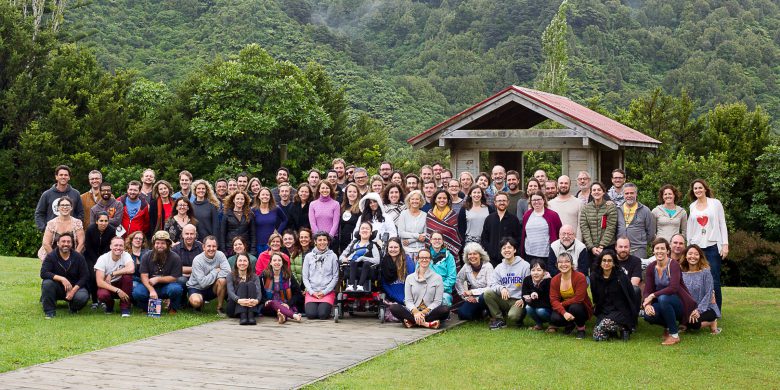
De WAR invites you to visit Koppelting, an annual grassroots festival about peer production and free/libre alternatives for society. A week filled with workshops, lectures, demonstrations, and talks about grassroots organisations and peer production. Come and knit with algae. Get acquainted with blockchain. Take part and think about what a peer-to-peer justice system could look… Continue reading
Ghent’s Quick Rise as a Sustainable, Commons-Based Sharing City
Cross-posted from Shareable. Maira Sutton: A renewable energy cooperative, a community land trust, and a former church building publicly-controlled and used by nearby residents — these are just a few examples of about 500 urban commons projects that are thriving in the Flemish city of Ghent in Belgium. A new research report shows that within… Continue reading
Team Human: Silvia Zuur “Progress through collaboration”
http://teamhuman.fm/wp-content/uploads/2017/02/TH-23-Silvia-Zuur.mp3 Playing for Team Human today is Silvia Zuur. In 2012, Zuur founded Chalkle to reignite adult education in New Zealand. Today, Zuur serves as a director at Enspiral, a social impact network that builds community driven solutions for a diverse set of issues including education, funding, and cooperative organizing. Enspiral is famously home to Loomio, a cooperative… Continue reading
How Wiki Loves Women is Growing Wikipedia Coverage About Women in Africa
Cross-posted from Shareable. Kristine Wong: Almost everyone who searches for information has used Wikipedia, the online encyclopedia with over 40 million articles (in roughly 300 languages) written and edited by volunteers around the globe. Yet despite the whopping amount of information Wikipedia contains, less than 20 percent of all Wikipedia contributors in 2015 were women, according to the Wikimedia… Continue reading
Patterns of Commoning: OpenSPIM, A High-Tech Commons for Research and Education
Jacques Paysan: Scientific and medical research critically depends on being able to observe very small structures that are invisible to the naked eye. Neuroscientists seeking to find cures for injury-induced paralysis, for example, may want to be able to observe the axons of regenerating neurons on coated nanowires. This kind of experiment often requires extremely… Continue reading
Why Use Creative Commons Licenses?
Even though Creative Commons licenses have been around for more than a decade, I am always surprised to learn that many progressive-minded activists, artists and academics – the people who should be most enthusiastic about the licenses – know nothing about them or at least don’t use them. A big welcome, then, to a new… Continue reading
Platform Coops Looking for the Next Steps
Cross-posted from Platform.coop Alexandre Bigot-Verdier, Lieza Dessein and Thomas Doennebrink: The past year has been an exciting one for the platform coop movement. In December 2016, Nathan Schneider launched the “Buy Twitter” campaign. Twitter was for sale and he suggested that its users buy it and to change its legal structure into a cooperative. This would… Continue reading
De Besturing – From tenancy to collective ownership
Quite a few European cities, like Ghent in Belgium, are initiating policies for the temporary usage of empty city spaces by civic coalitions, up until the time when real estate companies start re-developing these urban areas. While offering temporary solutions, this policy does not directly challenge neoliberal real estate speculation and the lack of space… Continue reading
Podcast: What Would an Economy Based on Wellbeing Look Like?
In last week’s episode Upstream explored the theme of economic inequality and looked at how neoliberal policies have impacted many communities, including Frome. This week’s episode asks the following question: How can towns and communities around the world begin to make wellbeing and happiness the ultimate goal of their economy? Upstream takes a look at… Continue reading
Book of the Day: Four Futures by Peter Frase
Peter Frase. Four Futures: Life After Capitalism (London and New York: Verso, 2016). Frase’s book builds on Rosa Luxemburg’s prediction a hundred years ago in the Junius Pamphlets that “[b]ourgeois society stands at the crossroads, either transition to socialism or regression into barbarism.” Specifically, he sketches — in very broad strokes — two versions of socialism and two versions… Continue reading